
Evidence-Based Mobility Device Prescription Services

The Assistive Devices Program (ADP) only funds devices for daily mobility within your home. They do not have requirements about how you transfer in and out of your wheelchair, or use the device outside the home, but it is important for you and your occupational therapist (OT) to problem solve so that your device fits your lifestyle. This is why evidence-based mobility device prescription services are essential. You might wonder, how does this work?
To have a good quality of life, you need to be able to participate in activities that are meaningful to you. When health challenges and disabilities stand in your way, seeing your options clearly can be overwhelming and difficult. An OT will listen to what you need and the challenges you encounter so that they can offer solutions. Your OT will help you make informed choices by answering your questions about device options, and ADP and other funding supports, then create a service plan for you based on what is important to you.
Other than understanding ADP and disability support options in Ontario, the OT is responsible for keeping up-to-date on Best Practice guidelines and scientific research that can improve the mobility device provision process. Two well-informed guidelines come from the World Health Organization (WHO, 2023) and the Rehabilitation Engineering and Assistive Technology Society of North America (RESNA, 2011). Although the RESNA guide is much older than the WHO guide, it is very similar in its recommendations, and remains relevant today.
WHO and RESNA steps for appropriate device prescription are almost the same, and both are aligned with the methods and spirit of occupational therapy. All emphasize the importance of centring the device user in the prescription process, and prescription being performed by a trained professional (such as an OT). You know best what your challenges are, and what you want to be able to achieve. The OT develops a Service Plan by integrating what they learn from you with an understanding of current technology, medical conditions that impact mobility, best practice guidelines, the ADP criteria and a general understanding of disability management. With That Wheelchair Guy, you have the final say on the Service Plan and how you participate, at every stage.
If you have caregivers or people who support you and you want them to be involved, their input can be tremendously valuable in making sure your device is as useable and safe as possible. Sometimes a caregiver or supportive person will remember other challenges or needs that you have because they have a unique perspective too. As long as the device user is comfortable with it, collaborating usually leads to a better prescription.
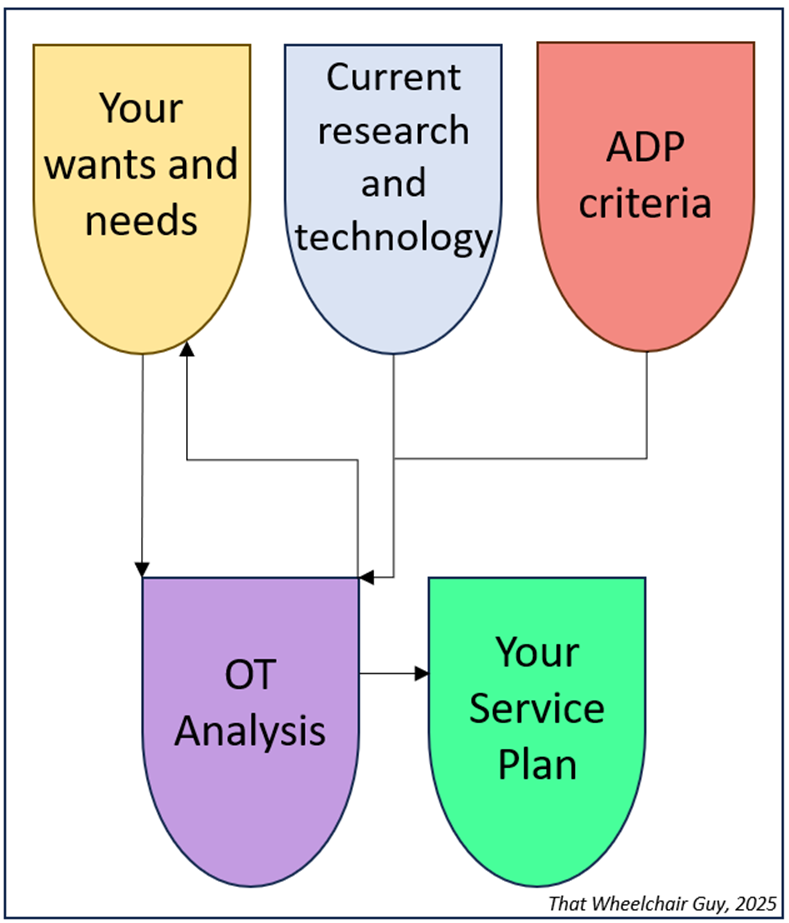
In sum, evidence-based mobility device prescription services depend on your participation, and a trained professional's skills and experience with relevant scientific research and technology. Partner with That Wheelchair Guy today so he can make the process of getting your mobility device straightforward and successful. Not sure? A brief Discovery Call with Henry to co-create a possible Service Plan is free of charge.


Comments